
Title: Why Fitness and Recovery Circles Are Obsessed with BPC-157 and TB-500: Real-World Peptide Use and the Limits of Evidence
From Gym to Clinic: Why Peptides Went Mainstream
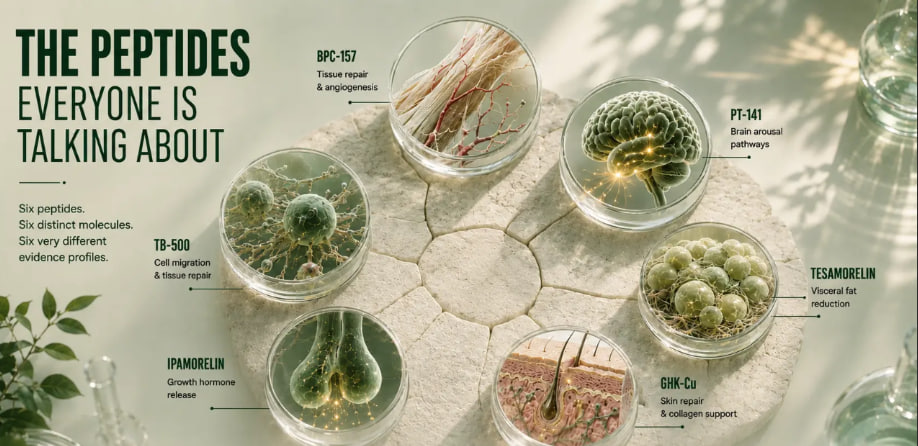
In fitness, bodybuilding, and recovery communities, BPC-157 and TB-500 have become almost synonymous with "recovery miracles." Online, they are often called the "Wolverine Stack," with users reporting faster wound healing and soft tissue recovery. Meanwhile, Ipamorelin and Tesamorelin are used for body composition and growth hormone support, while PT-141 and GHK-Cu attract attention in sexual health and skin repair. But the evidence behind these use cases varies widely.
BPC-157: The Most Animal-Studied Recovery Peptide
BPC-157 is a synthetic pentadecapeptide derived from human gastric juice protein, classified as a cytoprotective agent. Preclinical studies show effects on angiogenesis, nitric oxide signaling, and growth factor activity. A 2025 systematic review in Orthopaedic Sports Medicine (Vasireddi et al.) reviewed all studies on BPC-157 and musculoskeletal injury recovery, concluding it shows promise in animal models of tendon, ligament, muscle, and connective tissue healing. Human trials remain scarce.
TB-500: Actin Regulation and the "Wolverine Stack"
TB-500 comes from the active region of thymosin beta-4, a naturally occurring 43-amino-acid protein involved in cell motility, wound healing, and tissue regeneration (Maar et al.). One key mechanism is binding G-actin and helping transport it to injury sites. Its combination with BPC-157 is popular in fitness circles, but evidence remains mainly animal-based and anecdotal.
Ipamorelin: The "Clean" Growth Hormone Peptide
Ipamorelin is a synthetic pentapeptide and one of the first highly selective GH secretagogues. It stimulates pituitary GH release via GHS-R1a without significantly raising cortisol, ACTH, prolactin, or appetite. Compared with earlier secretagogues like GHRP-6, its response is more targeted. Raun et al. described it in detail in the European Journal of Endocrinology in 1998. It is popular in anti-aging, recovery, and bodybuilding, but large-scale clinical evidence is limited.
Tesamorelin: The Only FDA-Approved Fat-Loss Peptide
Tesamorelin is a synthetic GHRH analog approved in 2010 as Egrifta for reducing visceral abdominal fat in HIV-related lipodystrophy. In March 2025, the FDA approved EGRIFTA WR, a once-weekly formulation. Two Phase III trials involving 816 patients showed significant visceral fat reduction versus placebo. A 2024 study in HIV patients on integrase inhibitor regimens reported results consistent with earlier trials. However, the strongest evidence remains in HIV-related lipodystrophy, not general fitness fat loss.
PT-141 and GHK-Cu: Sexual Health and Skin Repair
PT-141 (bremelanotide, Vyleesi) is an FDA-approved cyclic heptapeptide that activates MC3R and MC4R receptors in the hypothalamus and limbic system. It is approved for premenopausal HSDD. GHK-Cu is a naturally occurring copper-binding peptide that declines with age, from about 200 ng/ml at age 20 to about 80 ng/ml at age 60. Multiple controlled human studies show improvements in skin density, collagen synthesis, wrinkle depth, and elasticity.
The Shared Limitation: Injection and Rapid Breakdown
Nearly all peptides require injection because oral administration leads to rapid breakdown by digestive enzymes. Short half-lives mean precise dosing strategies are necessary. This is a shared biological flaw across the category.
Conclusion
Fitness and recovery communities have real biological effects to point to with BPC-157, TB-500, Ipamorelin, and Tesamorelin, but clinical validation varies widely. Understanding each peptide's evidence boundary matters more than following the hype.